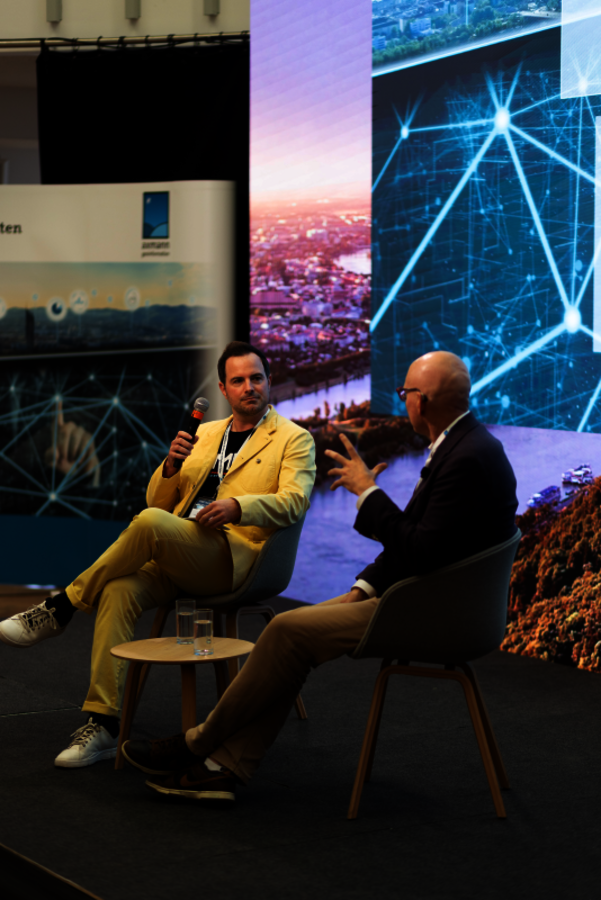
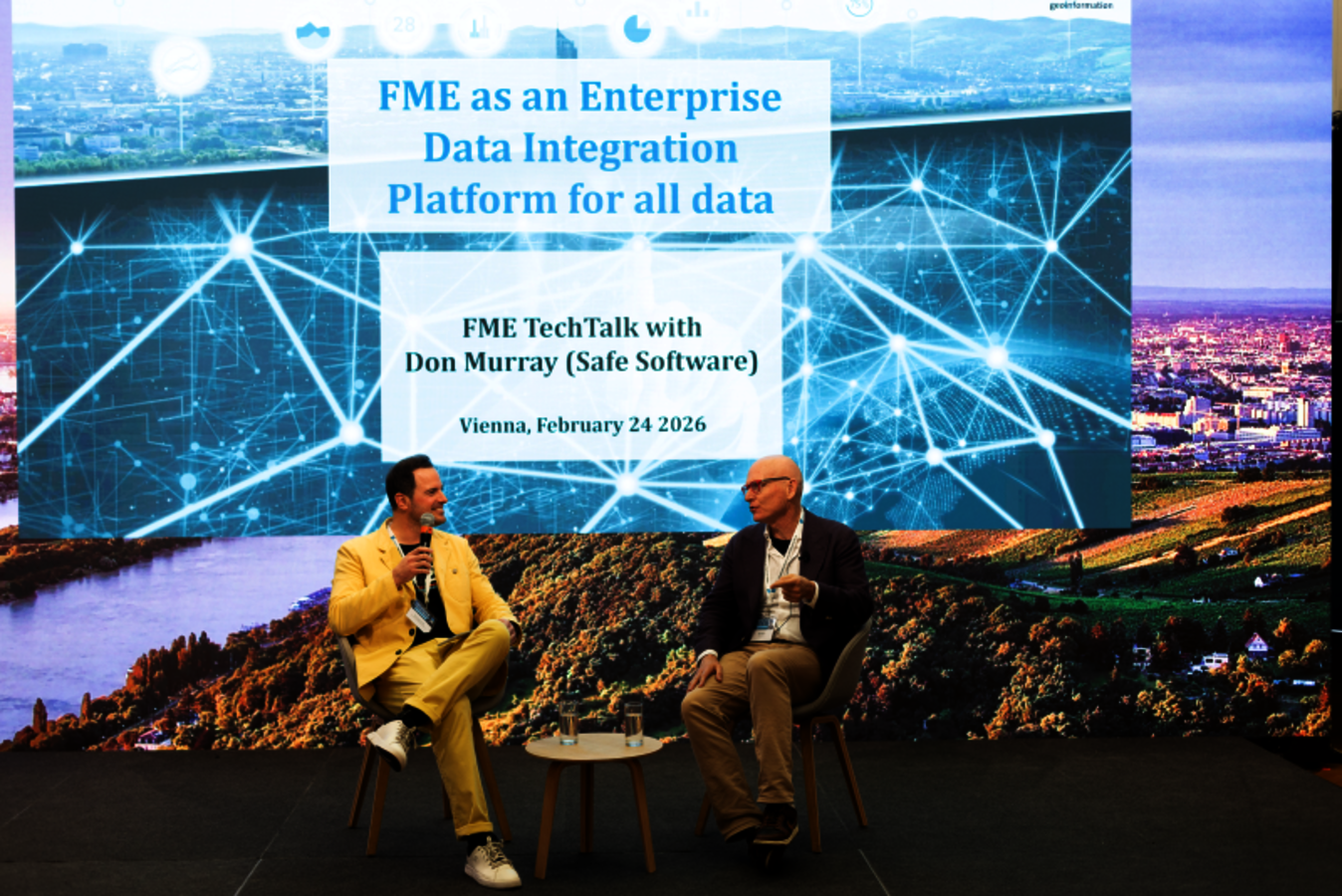
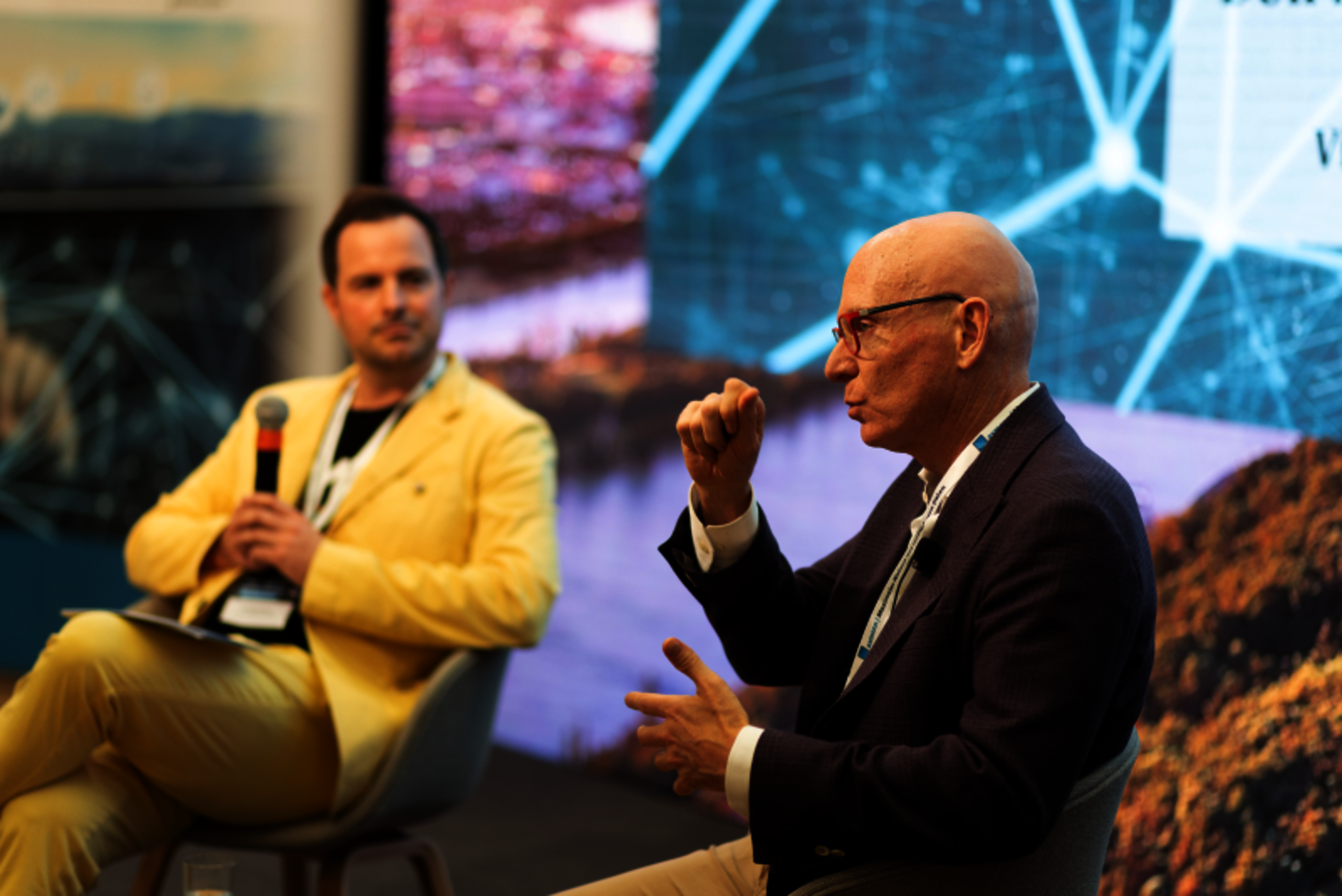
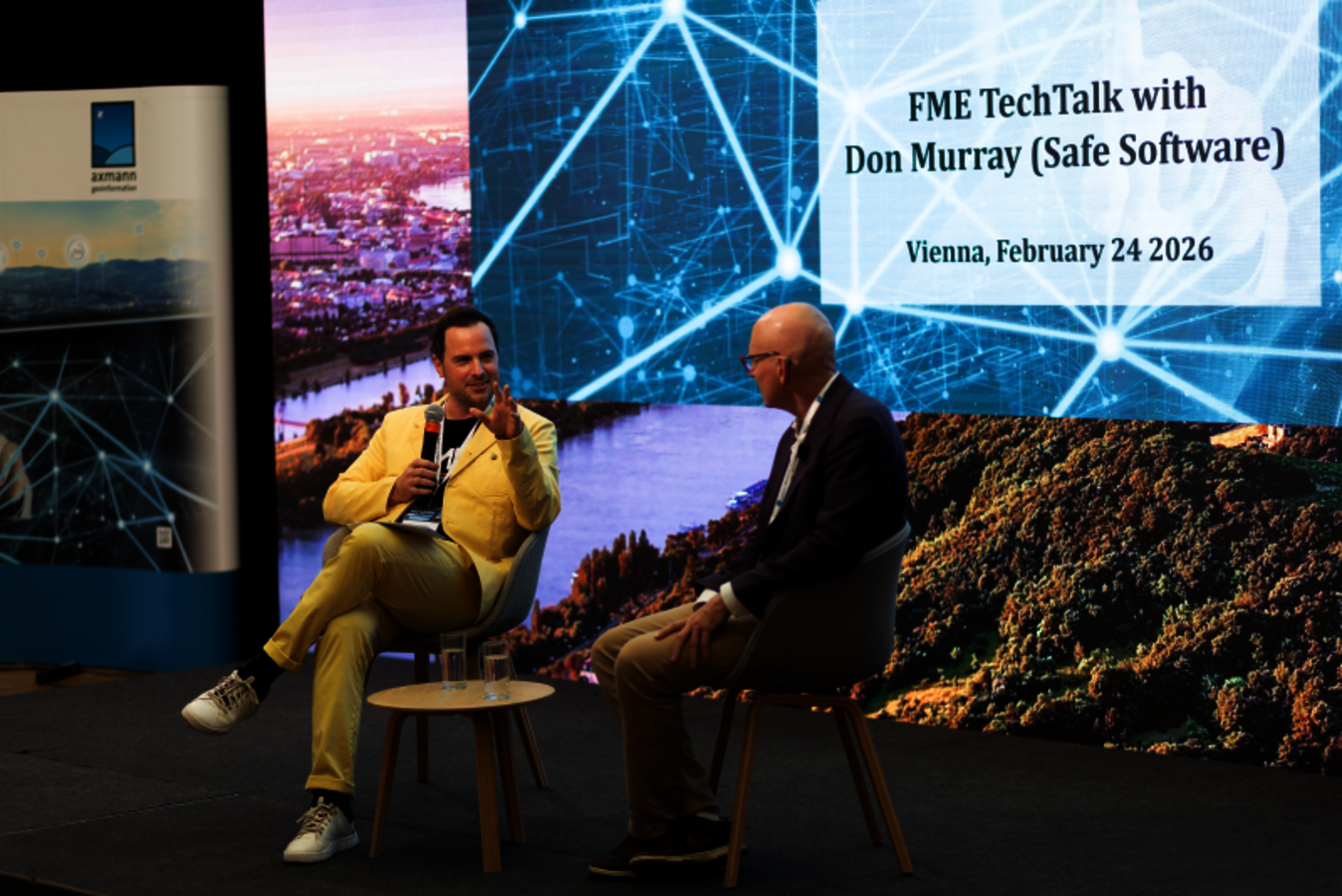


Don Murray, co-founder and CEO of Safe Software, visited axmann geoinformation in person in Vienna in February 2026 due to the positive development and increasing demand for FME software in Austria. Managing Director Christoph Kircher took the opportunity to interview the charismatic Canadian and inventor of the data integration platform.
Christoph Kircher: Don, what originally inspired you to develop FME and what convinced you that this approach was really new?
Don Murray: In 1993, Dale Lutz and I submitted a proposal for a project in the forest industry in British Columbia with a focus on data exchange. I was convinced that there must already be someone who specialized in exactly that for geodata. But when we looked around, we realized that this gap really existed, so we did it ourselves.
About two years later, we had FME in front of us in a really unwieldy first version – without a workbench, of course. And the name? It came to us in the middle of the night. We probably should have thought about it a little longer. (laughs)
Christoph Kircher: You regularly visit European countries, partners and customers on your business trips. What key challenges do you see in Europe and do you notice any differences to the North American market?
Don Murray: Yes, definitely. There are significantly more standards in Europe. Initiatives like INSPIRE focus heavily on interoperability. If a dataset is in a standard format like IFC, you know you can work with it.
In North America, it's different: providers are much more locked into proprietary systems and central governments often don't have enough authority to enforce standards. In Canada, there is often no national standard for many areas - it's almost like the Wild West. For us as a company focused on data interoperability, that's not necessarily a disadvantage. There are even standards where our software is the only one that can read and write them. But overall, the standard landscape is one of the main differences between the two markets.
Christoph Kircher: In Austria and Europe, many organizations are investing heavily in digital transformation and are facing organizational, technical and cultural challenges. In your experience, what are the biggest obstacles?
Don Murray: The biggest challenge is not so much technological - it's a "carbon-based" problem. In other words, people. Many simply don't like change, and it can be difficult to get everyone on board with new technologies and processes.
Personally, I love change - but I'm not a good change manager. (laughs) Fortunately, the rest of the team helps. People are often very attached to the tools they are used to. Telling them to give up something they've relied on for years is no easy task.
AI is a good example of this. At Safe Software, we are enthusiastic about it and use it internally in many different ways. I keep emphasizing: AI will not take away jobs - it helps people to focus on more interesting and meaningful tasks. There is always more to do, and when AI automates certain processes, it creates time and space for other activities. So the real challenge of digital transformation is usually not the technology - but ensuring that the team is willing and able to embrace the change.
Christoph Kircher: FME is well known in GIS departments - but IT departments have often never heard of it. When people say that FME can do "almost anything", it quickly sounds too good to be true. IT architects often prefer specialized tools with a clear focus. How does Safe Software deal with this?
Don Murray: That is definitely a challenge. What's more, once you use FME for a specific problem, you often use it for years for exactly that purpose - without checking what the platform can do in the meantime. When we visit customers and show them functions such as data virtualization, automation or real-time streaming, many are completely surprised.
People like to put things into simple categories. Even internally, I sometimes have to correct people when they say we are "just an ETL tool". ETL is one function - but by no means the only one. Automation, for example, is one of the most frequently used functions today because nobody wants to initiate processes manually anymore.
However, we are increasingly gaining visibility in the IT world, partly due to our presence in the Gartner Magic Quadrant. However, the real challenge remains that IT departments often already have enterprise integration platforms in use and want to align everything with them. In doing so, they overlook the fact that classic tools often reach their limits with the complexity of geodata.
Christoph Kircher: Let's talk about data quality: "Garbage in, garbage out" - we know this all too well in the geodata sector. What best practices do you recommend for sustainable and trustworthy data flows with FME?
Don Murray: Data quality is a battle that will never be completely won - but you can't stop fighting it. Data by its very nature becomes obsolete: Customers move, addresses change and suddenly the information is no longer correct.
What I particularly appreciate is the approach of automated data quality checks. With FME Flow, you can set up a validation service that automatically checks all incoming data - based on predefined rules, with immediate feedback. This is particularly valuable when receiving data from third parties: upload data and know immediately whether it meets the required specifications. Incidentally, Google uses a similar approach with FME in its own cloud environment for data checks.
I take a particularly critical view of data quality in conjunction with AI. It can process enormous amounts of data efficiently, but it cannot distinguish between right and wrong. Incorrect data leads directly to hallucinations. Robust validation processes are therefore not an option, but a necessity.
Christoph Kircher: Data quality creates trust - but security is just as critical today. IT penetration tests and cyber security strategies have long been part of everyday life. How does Safe Software deal with this challenge?
Don Murray: We've come a long way. In the beginning, FME Server had no security function at all - anyone who knew the URL had access. Later, security aspects were added, but as an optional function that had to be activated manually. Today, of course, it is built in as standard.
We have a dedicated security team and continuously optimize with each version. In FME Flow, users cannot execute arbitrary commands, all parameters are treated as plain text by default. In addition, there is SAML support, a redesign of FME Flow so that tokens no longer appear in URLs, and the planned introduction of OAuth authentication.
Since our beginnings, the world has changed significantly in terms of security and we have adapted accordingly.
Christoph Kircher: Once quality and security are the foundations, how is innovation taking things forward? What role do AI and machine learning play in the evolution of FME?
Don Murray: We've been experimenting with AI for almost twenty years - but generative AI was a real game changer. When we first saw it, it was immediately clear: this is something completely different.
We want to enable organizations to use any AI they want - be it Databricks, Snowflake or others. We make sure that their data goes to their preferred AI platform.
A concrete example is the soon-to-be-released MCPCaller transformer, which allows users to share any FME workspace with AI - the AI interacts with it and returns results. The underlying Model Context Protocol was not originally designed as an AI tool, but has proven to be extremely flexible. As a result, FME is increasingly becoming an orchestrator - it controls the flow of workspaces, some of which wait for AI processes in the background, and thus enables complex, cascading automation.
Christoph Kircher: How do you see the geoinformatics industry changing in the coming decade, and what role does Safe Software hope to play in shaping this transformation?
Don Murray: Data will continue to grow in importance. AI needs data, and together AI and data will reshape industries and increase productivity. Much of our development and future announcements will be focused on evolving from an integration company to an orchestration company.
Christoph Kircher: Safe Software has recently undergone significant changes - change of ownership, rebranding, price adjustments, new subscription model. For long-standing customers, trust in continuity is essential. How can they be sure that Safe Software's core values will remain unchanged?
Don Murray: My co-founder Dale decided to step down after 30 years. As I didn't have the means to take over his share myself, we brought JMI on board as an equity partner. At the same time, we had planned to standardize our desktop products anyway. The new subscription model allows customers to scale their usage flexibly. Our promise is clear: if you use ten engines today, you will also have access to ten engines next year - without any major price jumps. The ultimate goal remains unchanged: FME should be the technology that offers our customers the greatest value. Nothing has changed in this respect.
Christoph Kircher: FME has had an impressive journey - from a simple converter between DWG and Shapefile to an enterprise-wide data integration platform. How do you see the future of data integration?
Don Murray: There is still a lot to do. A key topic on our roadmap is data lineage: where does a dataset come from, what created it, where is it used? We are working on making FME more data-centric instead of workspace-centric. In the future, organizations will be able to click on any data set and immediately see where it comes from and where it is being used.
This also has a tangible business benefit: You could discover that the organization is paying for data that no one is using - or understand why certain data is simply not being used. Data lineage is increasingly becoming a crucial issue.
Christoph Kircher: Thank you very much for the interview, Don!
Christoph Kircher, Managing Director of axmann geoinformation in conversation with Don Murray, xo-founder and CEO of Safe Software. Photos © studionext